SkillHuntRANKED DAILY

Live skill

write-like-me

Drafts posts, emails and essays in your own voice, learned from your samples. Each correction makes the next one closer.

write-like-me learns how you write from 3 to 10 pieces you wrote yourself, then drafts, edits and checks writing in that voice. It keeps a small library per writer: twelve measured voice dials (sentence length, word choice, opinion versus evidence, person, openers, closers and more), the stances you take, your stories, sentences you've approved, and words you've rejected. When a draft isn't you, it finds the one dial that's off and moves it instead of rewriting the piece, then logs the change with the quote that caused it. It never invents a story, number or credential. If a post needs a personal detail it doesn't have, it leaves a marked slot. If a piece takes a side you haven't taken, it asks. Every draft goes through a bundled no-ai-slop pass and a script that flags banned words and phrases you've rejected. For founders, marketers and anyone who writes in public and is tired of drafts that sound like everyone else. Built on Nicolas Cole's ghostwriting model (language is open source, voice is a set of dials).

Why try it

I write in public and kept getting drafts that sounded like everyone else. This learned my voice from six of my blog posts, reuses lines I've already written, and leaves a gap instead of inventing a story. Fixing one dial beats rewriting the post.

Writing

Works with Claude Code

Hunted by @akash · MakerLive since Oct 28, 2026
Before and after

The same prompt, without and with the skill

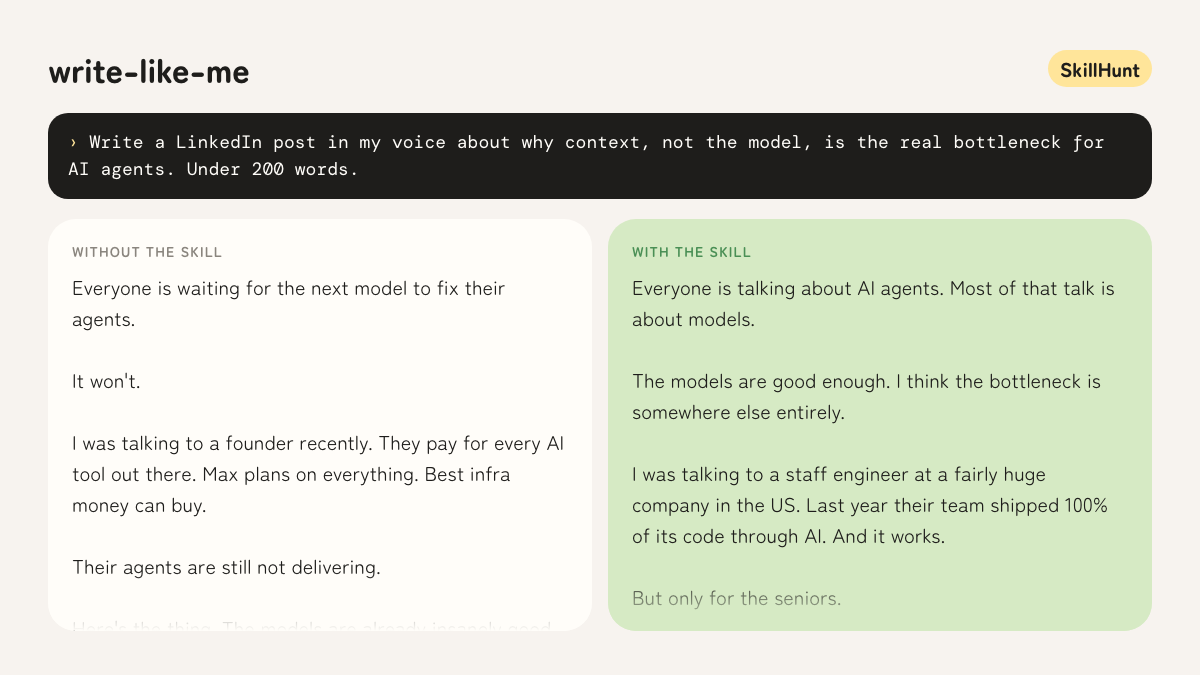
›Write a LinkedIn post in my voice about why context, not the model, is the real bottleneck for AI agents. Under 200 words.

Without the skill

Everyone is waiting for the next model to fix their agents. It won't. I was talking to a founder recently. They pay for every AI tool out there. Max plans on everything. Best infra money can buy. Their agents are still not delivering. Here's the thing. The models are already insanely good. Give Opus or Codex the right context and it can do a very complicated job in a single prompt. The problem is the "right context" part. The practices your team followed for years are not written down anywhere. Why the APIs look the way they do. Which PR broke prod. Which customer email actually got a reply. All of it lives in the heads of people who were there. So the agent guesses. A senior engineer can fill those gaps in one prompt. A junior engineer can't. Neither can the agent. We have version control for code. We have nothing for decisions. That's the missing layer. A system of record for the why behind every irreversible action. Across engineering, customers, everything. A better model with thin context is still a Formula 1 engine with no steering wheel. Fix the context. The speed follows. Cheers.

With the skill

With the skill, test prompt 1

Everyone is talking about AI agents. Most of that talk is about models. The models are good enough. I think the bottleneck is somewhere else entirely. I was talking to a staff engineer at a fairly huge company in the US. Last year their team shipped 100% of its code through AI. And it works. But only for the seniors. A senior engineer gets a complicated job done in a prompt or two. A junior engineer on the same team, with the same models and the same tools, keeps getting stuck. Why? Because the practices that team followed for years are not recorded anywhere. Juniors do not know what was tried before and failed. They do not know which tradeoffs were made and why. So they cannot give the agent the right context. The magic isn't in the model. The magic is in the context. We have version control for code. We have nothing for the decisions that actually matter. Rule of thumb: If your agent keeps getting stuck, fix what it knows before you swap the model. Cheers.

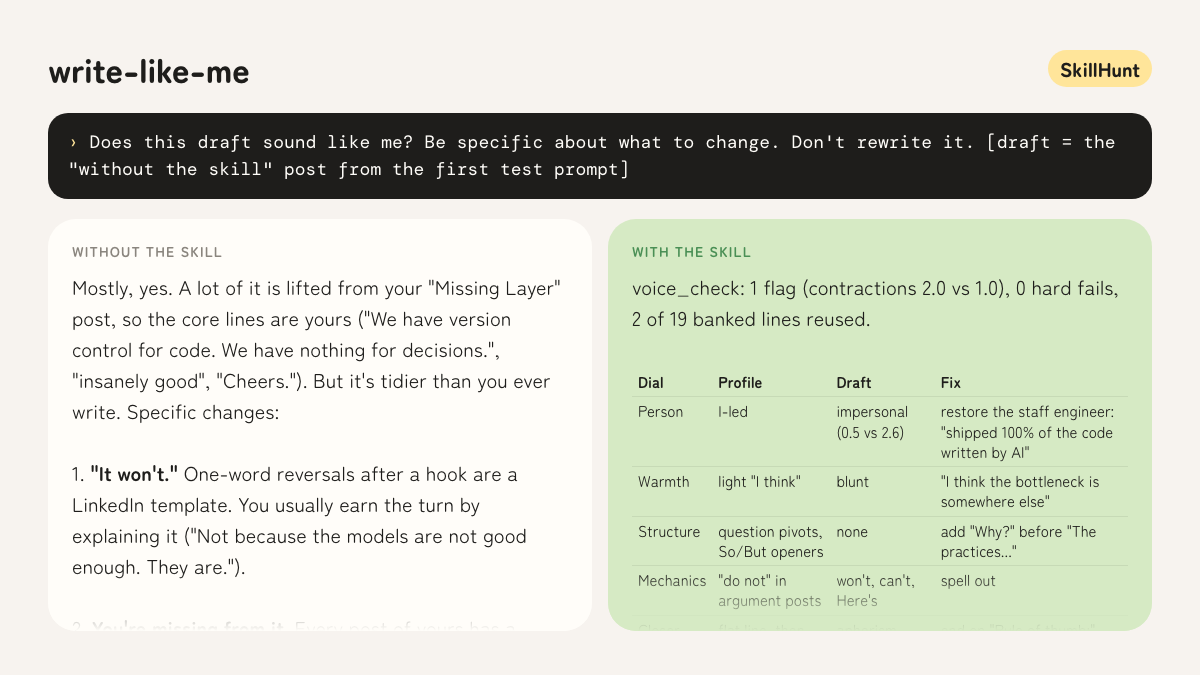
›Does this draft sound like me? Be specific about what to change. Don't rewrite it. [draft = the "without the skill" post from the first test prompt]

Without the skill

Mostly, yes. A lot of it is lifted from your "Missing Layer" post, so the core lines are yours ("We have version control for code. We have nothing for decisions.", "insanely good", "Cheers."). But it's tidier than you ever write. Specific changes: 1. **"It won't."** One-word reversals after a hook are a LinkedIn template. You usually earn the turn by explaining it ("Not because the models are not good enough. They are."). 2. **You're missing from it.** Every post of yours has a stake: "I tried it seriously," "I made this mistake," what you're building. Add one line on why this bugs you, or mention Action Records. 3. **Bring back the staff engineer.** "A senior engineer can fill those gaps... A junior engineer can't" is abstract. Your real proof is the team that shipped 100% AI-written code and still had juniors stuck. One sentence of that beats three general ones. 4. **"Fix the context. The speed follows."** Neat closing couplets aren't your style. Your own line was better: "The speed is there. The control is not." Or end on a question, like you do in "What will you build this week?" 5. **Rhythm.** Every line is short and punchy. You normally let one or two sentences run long with "and" and "I think." Loosen one paragraph so it reads like you talking. 6. **"Across engineering, customers, everything."** "Everything" is filler. Name a third thing, or cut it.

With the skill

With the skill, test prompt 2

voice_check: 1 flag (contractions 2.0 vs 1.0), 0 hard fails, 2 of 19 banked lines reused. | Dial | Profile | Draft | Fix | |---|---|---|---| | Person | I-led | impersonal (0.5 vs 2.6) | restore the staff engineer: "shipped 100% of the code written by AI" | | Warmth | light "I think" | blunt | "I think the bottleneck is somewhere else" | | Structure | question pivots, So/But openers | none | add "Why?" before "The practices..." | | Mechanics | "do not" in argument posts | won't, can't, Here's | spell out | | Closer | flat line, then Cheers | aphorism | end on "Rule of thumb:" | | Verdict | | | close, one dial off (person) | Slop: - "Here's the thing." Throat-clearing. Cut. - "Fix the context. The speed follows." Fake-profound kicker. Delete. - Formula 1 line as kicker. Move it mid-piece, banked wording: "no steering wheel and no rearview mirror". Banked, unused: "The magic isn't in the model. The magic is in the context."; version-control line verbatim ("the decisions that actually matter"); the 200-bug Linear migration. Stance: "It won't." can read against your AGREE on building for the next model. You'd recognize it as yours, but it reads like your argument with you taken out.

Documentation

Install and use it

Install

Copy the folder into a skills directory:

git clone --depth 1 https://github.com/drevon-dev/awesome-gtm-skills.git
# one project
cp -r awesome-gtm-skills/skills/write-like-me <project>/.claude/skills/
# every project
cp -r awesome-gtm-skills/skills/write-like-me ~/.claude/skills/

Needs Python 3.8+ (standard library only). The no-ai-slop skill is bundled inside, so nothing else to install.

Quick start

  1. Put 3 to 10 pieces you wrote yourself (no AI) into voice/<handle>/samples/, one file each.
  2. /write-like-me learn my style from voice/<handle>/samples
  3. Correct the profile summary it shows you (up to three things).
  4. /write-like-me write a LinkedIn post about <topic>
  5. Edit what's wrong and paste it back, or say "that's not me, the second paragraph". The profile updates and logs why.

Modes

  • learn: build the profile from samples plus a short interview
  • write: draft in your voice, reusing your approved lines
  • edit: make someone else's draft sound like you, moving only the dials that are off
  • check: a dial-by-dial table of how close a draft is, without rewriting
  • evolve: turn a correction into a logged profile change
  • add: "remember that I think cold email is dead"
  • status: what it knows about your voice

Example prompts

/write-like-me write a LinkedIn post about why we stopped doing cold email
/write-like-me does this sound like me? <paste draft>
/write-like-me that's not me, I'd never open with a question

Scripts

python3 scripts/voice_stats.py voice/<handle>/samples -o voice/<handle>/fingerprint.json
python3 scripts/voice_check.py voice/<handle> draft.md

voice_check.py exits 1 on a banned slop word or a phrase you've rejected, so it can gate a pipeline.